Ancient Indian Quotes: Timeless Wisdom from the Past
Ancient Indian Wisdom Quiz
Test Your Knowledge of Ancient Indian Wisdom
Answer these multiple-choice questions about the ancient Indian quotes and sources mentioned in the article. Each question has only one correct answer.
When you hear the phrase ancient Indian quote, you probably expect a short saying that still feels fresh today. In reality, these bits of wisdom come from texts that are thousands of years old, yet they speak directly to modern problems. Below we’ll explore where these lines originated, why they still matter, and how you can slip them into daily conversations without sounding pretentious.
Why ancient Indian sayings still resonate
India has a continuous written tradition that stretches back to the Rigveda, a collection of hymns composed around 1500 BCE. The verses were meant for rituals, but the underlying ideas-balance, duty, humility-are universal. Over centuries, philosophers distilled those ideas into pithy maxims that could be memorized and shared across generations. Because they were passed down orally, the language stayed simple, making the quotes easy to remember and apply.
Key sources of ancient Indian wisdom
Not every old Indian text contains quotable lines. Some are massive epics, others are ethical manuals. Here are the most quote‑friendly sources you’ll encounter:
- Rigveda - early Vedic hymns, mostly about cosmic order (ṛta).
- Upanishads - philosophical treatises that explore the nature of reality and self.
- Bhagavad Gita - a dialogue on duty, action, and devotion found within the Mahabharata.
- Tirukkural - a Tamil classic of 1,330 couplets covering ethics, politics, and love.
- Chanakya - the strategist behind the Mauryan empire, author of the Arthashastra.
- Kalidasa - a Sanskrit poet whose verses often hide moral lessons.
- Ashoka - Mauryan emperor whose edicts spread Buddhist values across the subcontinent.
Five timeless ancient Indian quotes and what they mean
- “Vasudhaiva Kutumbakam” - Rigveda.
Translation: The world is one family.
Why it works: It reminds us to treat strangers like relatives, a principle that eases conflict and builds empathy. - “Ahimsa Paramo Dharma” - Mahabharata (often linked to the Gita).
Translation: Non‑violence is the highest duty.
Why it works: In fast‑paced life, it nudges us to choose words and actions that don’t hurt. - “Aram Ellam Pennam Palliyavum” - Tirukkural (Couplet 1).
Translation: To live without desire is true wealth.
Why it works: It cuts through consumer pressure and shows happiness comes from within. - “Yatha drishti tatha srishti” - Chanakya.
Translation: As your vision is, so is your creation.
Why it works: It ties mindset to outcome, perfect for goal‑setting. - “Manushya naduval oduvari” - Kalidasa.
Translation: Between two people, a bridge of love can be built.
Why it works: It highlights that relationships need effort, not just feeling.
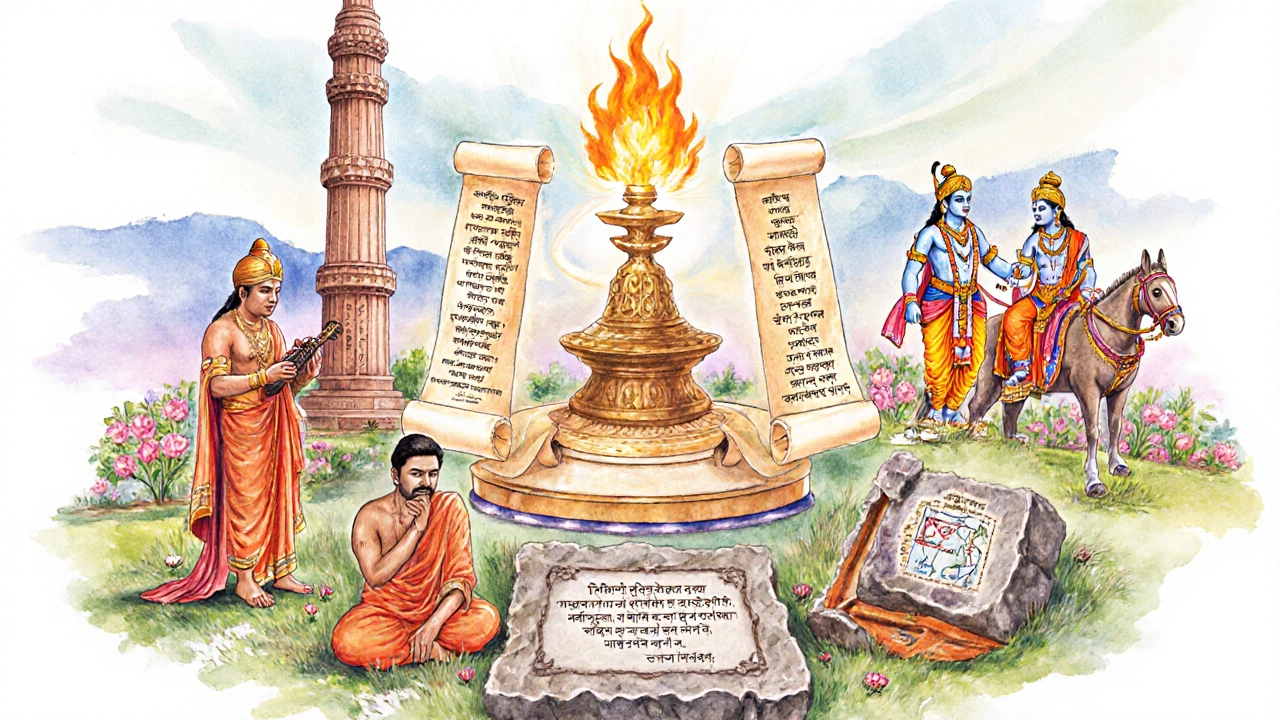
How to use these quotes in everyday life
Putting an old line into a modern chat can feel forced. Follow these simple steps:
- Pick a quote that matches the situation. If a coworker is stressed, try “Vasudhaiva Kutumbakam”.
- Explain it in one sentence. “It means we’re all part of the same family, so let’s support each other.”
- Show a small action that follows the idea-offer help, share a resource, or simply listen.
- Let the quote fade after the action. The impact comes from what you did, not how many times you repeat the line.
Using quotes like this turns them from academic trivia into living tools.
Common misconceptions about ancient Indian sayings
Many people think these quotes are all religious or only for scholars. That’s not true. The sources listed above cover secular ethics, politics, love, and personal growth. Another myth is that the language is too archaic for modern ears. When you translate them into simple English, the core idea remains clear. Finally, some assume every ancient Indian text is the same. In reality, each source has a distinct flavor-Vedic verses are more mystical, while the Arthashastra is brutally practical.

Quick reference: Source comparison table
| Source | Approx. Date | Primary Language | Typical Theme |
|---|---|---|---|
| Rigveda | 1500‑1200 BCE | Sanskrit | Cosmic order, duty |
| Upanishads | 800‑200 BCE | Sanskrit | Self, reality |
| Bhagavad Gita | 2nd century CE | Sanskrit | Action, devotion |
| Tirukkural | 1st century CE | Tamil | Ethics, love, politics |
| Chanakya (Arthashastra) | 3rd century BCE | Sanskrit | Statecraft, economics |
| Kalidasa | 5th‑6th century CE | Sanskrit | Poetry, moral insight |
| Ashoka’s Edicts | 3rd century BCE | Prakrit, Greek | Compassion, law |
Mini FAQ - all you might still wonder
What defines an "ancient Indian quote"?
It is a short, memorable line that originates from Indian literature or inscriptions that are at least 1,000 years old. The source can be a Vedic hymn, a philosophical treatise, a classical poem, or an imperial edict.
Are these quotes still relevant today?
Yes. They address human nature-greed, love, duty, fear-issues that never change. Modern readers simply translate the context into today’s language.
Where can I find authentic translations?
University presses, the Indian Council of Historical Research, and reputable translation projects (e.g., Penguin Classics) provide reliable English versions. Online, look for PDFs from academic institutions.
Can I use these quotes in business presentations?
Absolutely. Choose a quote that aligns with your message-like “Yatha drishti tatha srishti” for vision‑driven strategy-and credit the source in a footnote.
What’s the best way to remember these sayings?
Write the line on a sticky note, pair it with a visual cue, and repeat it aloud in the context where you need it. The more you apply it, the deeper it sticks.
Ancient Indian quotes are not just museum pieces; they are practical tools that cut through modern noise. Pick one, live it, and you’ll see how a thousand‑year‑old line can still spark change today.